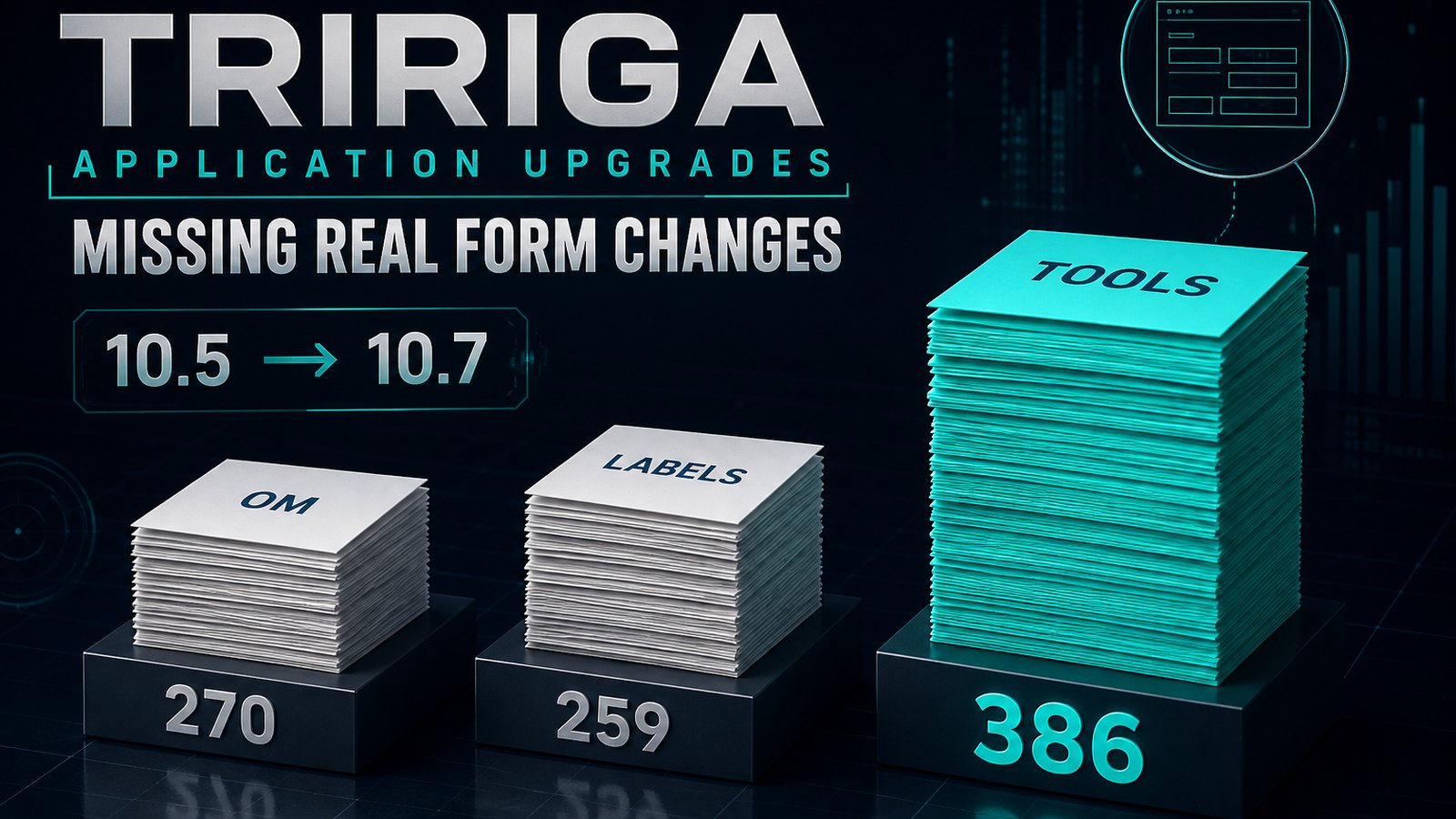
Continuing with my TRIRIGA 10.5.0.0 to 10.7.0.0 application upgrade analysis. I decided to do a little exercise. I took all of the application upgrade OM's between 10.5.0.0 and 10.7.0.0 and compiled a list of objects in each one. I then build a consolidated list of the objects. There are 345 distinct Forms spread throughout the upgrade packages.
I also wrote some SQL to dump out the Module, BO, Form Name, Gui_id, and Object Label of every form in the system. I then compared the output of this SQL from a 10.5.0.0 environment to the output from a 10.7.0.0 environment. From this comparison there are 75 new forms and 259 forms where the object label has changed. Combine those totals and you get 336 distinct Forms.
Finally I used my tools to dump out all of the forms in 10.5.0.0 and also in 10.7.0.0. I then compared the outputs to identify which objects are the same, different, or new. I get 75 new forms and 386 that have some sort of difference. For a handful of these forms the only difference is the modified date. I have excluded them from my result counts. There are also 112 forms where the only changes are due to the cached value of query names being changed. This must have been done via direct update in the database because nothing else is different, including the modified date. However, if they got cleaned up in the base product, they should get cleaned up during the upgrade.
So the bottom line is There are 75 New forms between 10.5.0.0 and 10.7.0.0. As for modified forms the count varies based on the method. Counting the forms in upgrade packages yields 270. Counting the forms based on object label yields 259. Finally, using my tools yield 386 forms that have changed. Take away the 112 where it's just the cached query names that change still leaves 274 forms.
Based on this I'd say most upgrades are not capturing all of the changes in the base product. This is true of upgrades I've done in the past as well. Thankfully, I am now better prepared for the next application upgrade I perform.
Comments (0)
No comments yet.
Sign in to comment.